
Wyandotte County Clerk Office
The official clerk page identifies the Clerk of the District Court as the court's official record keeper. It says deputy clerks are appointed to perform the same duties, records are entered chronologically, and parties are indexed alphabetically. That workflow explains why name searches and docket chronology matter in Kansas CaseSearch and at the public terminal.
The official Clerk of the District Court page is the assigned source for the clerk profile.
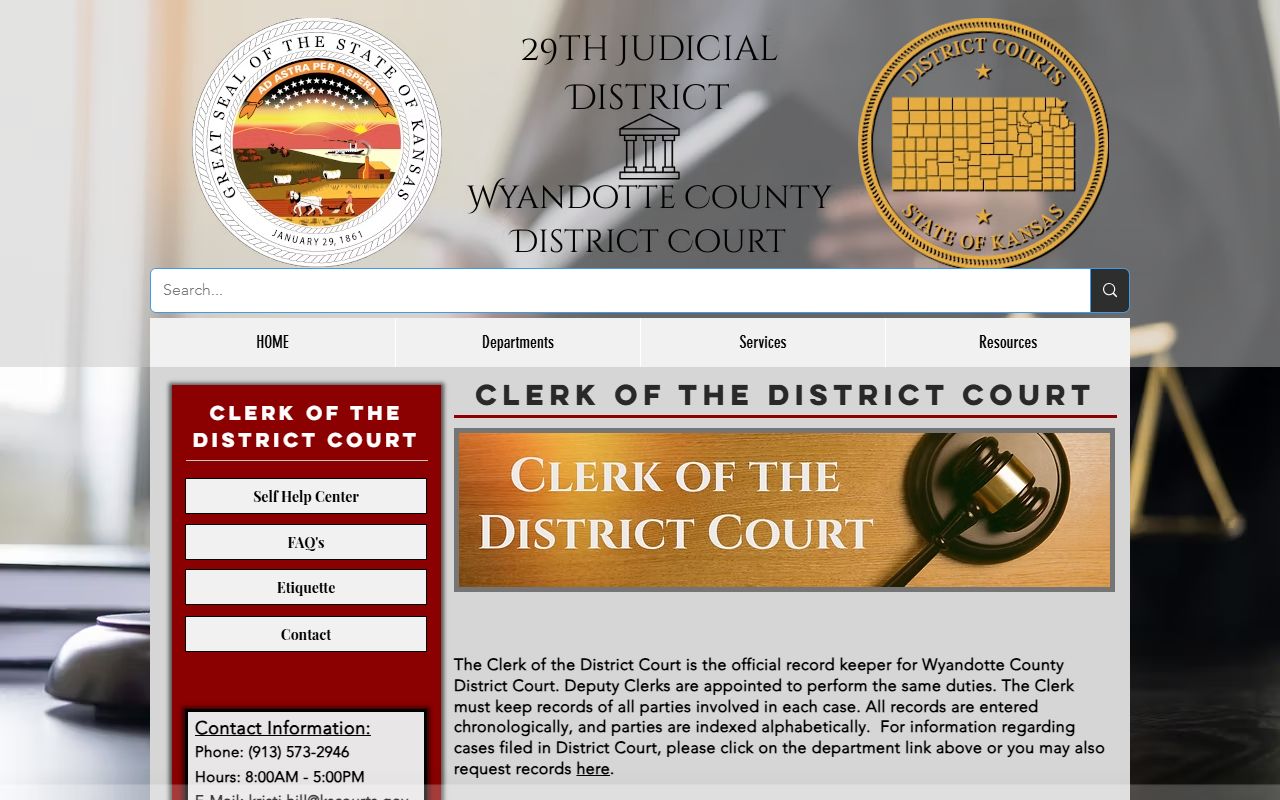
The page gives the clerk contact and confirms the office's role as the court-record keeper.
Clerk of the District Court
Wyandotte County Courthouse
710 N 7th St, Kansas City, KS 66101
913-573-2946
kristi.hill@kscourts.gov
Monday-Friday, 8:00 a.m. to 5:00 p.m.
What the Clerk Keeps
The clerk's office keeps District Court records for criminal, civil, domestic, probate, juvenile, small claims, limited action, protection order, and District Court traffic matters. Kansas does not use a Texas-style split where one clerk handles district cases and another handles county court criminal or probate case files. Wyandotte County does have a separate Unified Government Clerk for legislative records, ordinances, minutes, and non-court local government records, but court-record users should start with the District Court clerk.
| Record Type | Clerk or Department Channel |
|---|---|
| Criminal cases | Criminal Department, 913-573-2905 |
| Civil, domestic, protection orders | Civil Department, 913-573-2901 |
| Probate and marriage license | Probate Department, 913-573-2834 |
| Traffic from Highway Patrol or sheriff | Traffic Department, 913-573-4117 |
| Limited actions and small claims | Limited Actions/Small Claims, 913-573-2811 |
Request Clerk Records
The access channels are Kansas CaseSearch, the public terminal on the courthouse mezzanine, the relevant department counter, phone routing by case type, email when the department publishes one, and the court forms index. If the document is needed for legal use, ask the clerk what certified copy steps and fees apply because the research did not capture a full official copy-fee schedule.
- Search Kansas CaseSearch for the case number and party names.
- Confirm the case type and Wyandotte County District Court match.
- Identify the document needed, such as order, judgment, decree, or sentencing entry.
- Call the right department before visiting if certification, sealed access, or older records are involved.
- Request certified copies from the clerk or department, not from a third-party search result.
| Request Field | Required | Notes |
|---|---|---|
| Case number | Best if known | Use the exact District Court case number. |
| Party names | Yes when case number is unknown | Clerk indexing is alphabetical by party. |
| Document type | Yes | Order, decree, journal entry, judgment, or other filing. |
| Number of copies | Yes | State whether certified copies are needed. |
| Contact information | Yes | Needed for follow-up, fees, and pickup or delivery steps. |
Forms and Fees
The District Court forms index includes divorce packets, domestic relations affidavits, protection forms, eviction and small claims packets, name change, garnishment, expungement, probate reports, conservator inventory, small estate affidavit, subpoena, notice of appeal, and other filings.
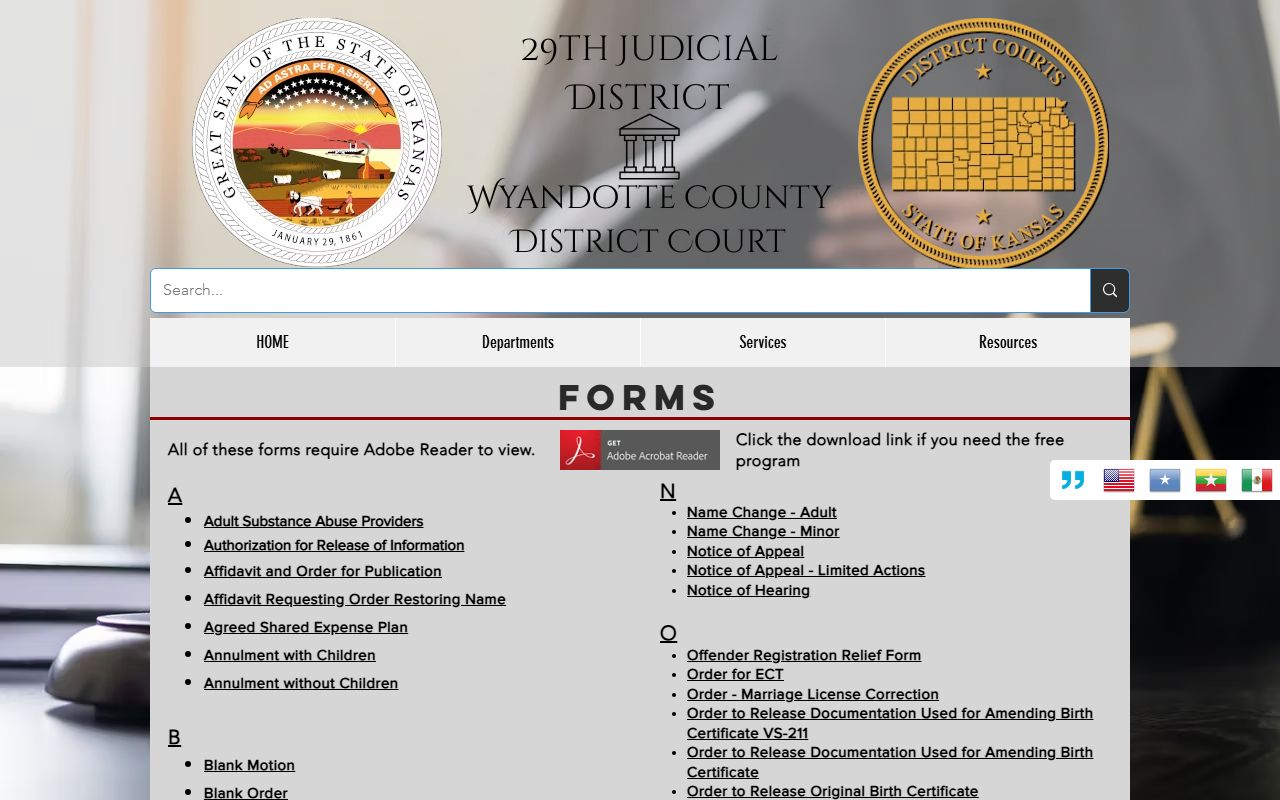
The forms index is useful for filing and request preparation, but it does not replace clerk review when a certified copy is needed.
| Item | Amount or Note |
|---|---|
| District court copy/certification fees | Precise local schedule not captured in the research; contact clerk before ordering. |
| Online traffic/criminal/juvenile card payment | 4% through CitePayUSA per official traffic page. |
| Marriage license | $85.50 appears on official Kansas district court pages, but local snippet did not show amount. |
| Small estate affidavit threshold | Under $75,000; form does not get filed with the clerk. |
Kansas Access Limits
The Clerk of the District Court follows Kansas court rules and public-records limits. Kansas Supreme Court Rule 22 controls public electronic access to district and appellate case records. KORA supports public inspection of public agency records, but K.S.A. 45-221 lists many exceptions. Juvenile, sealed, expunged, adoption, care and treatment, and protected personal information may be restricted.
The assigned statute images are K.S.A. 45-215 and K.S.A. 45-221.
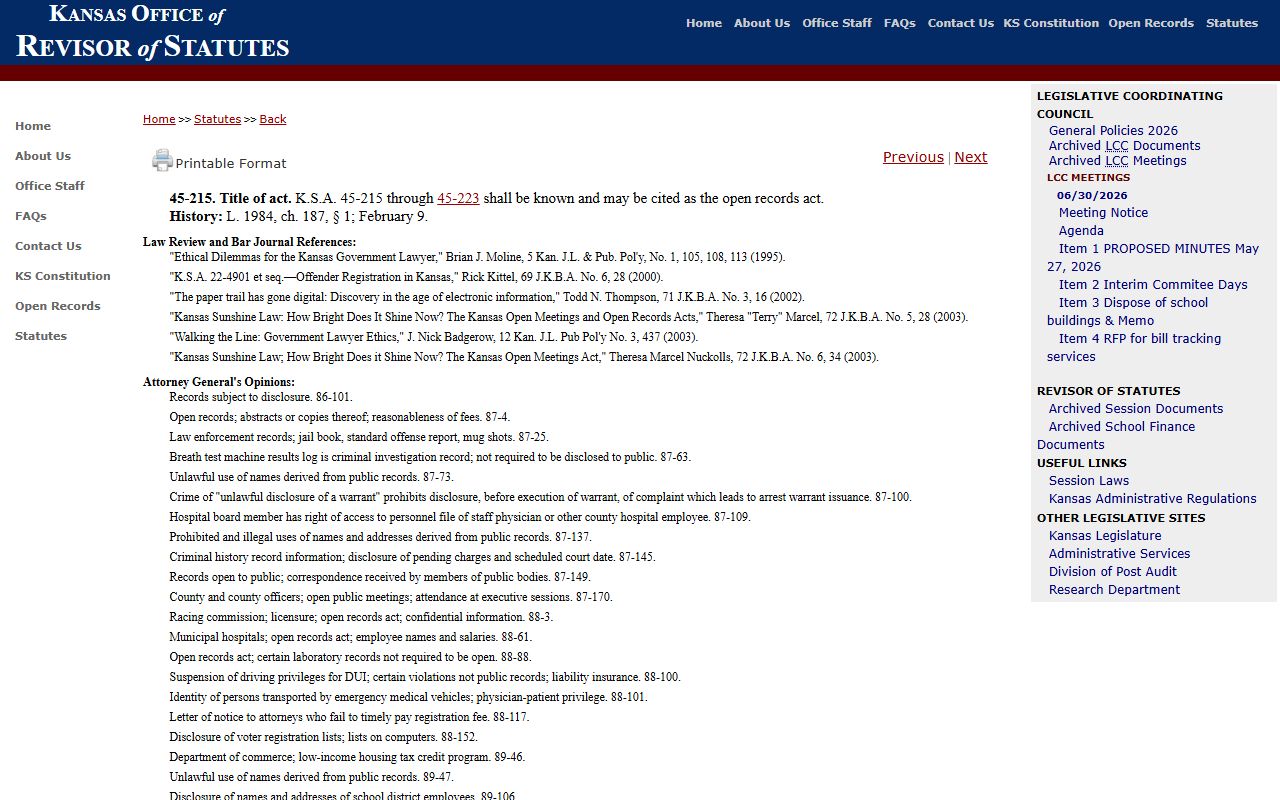
K.S.A. 45-215 states the public-records policy that supports inspection when no law closes the record.
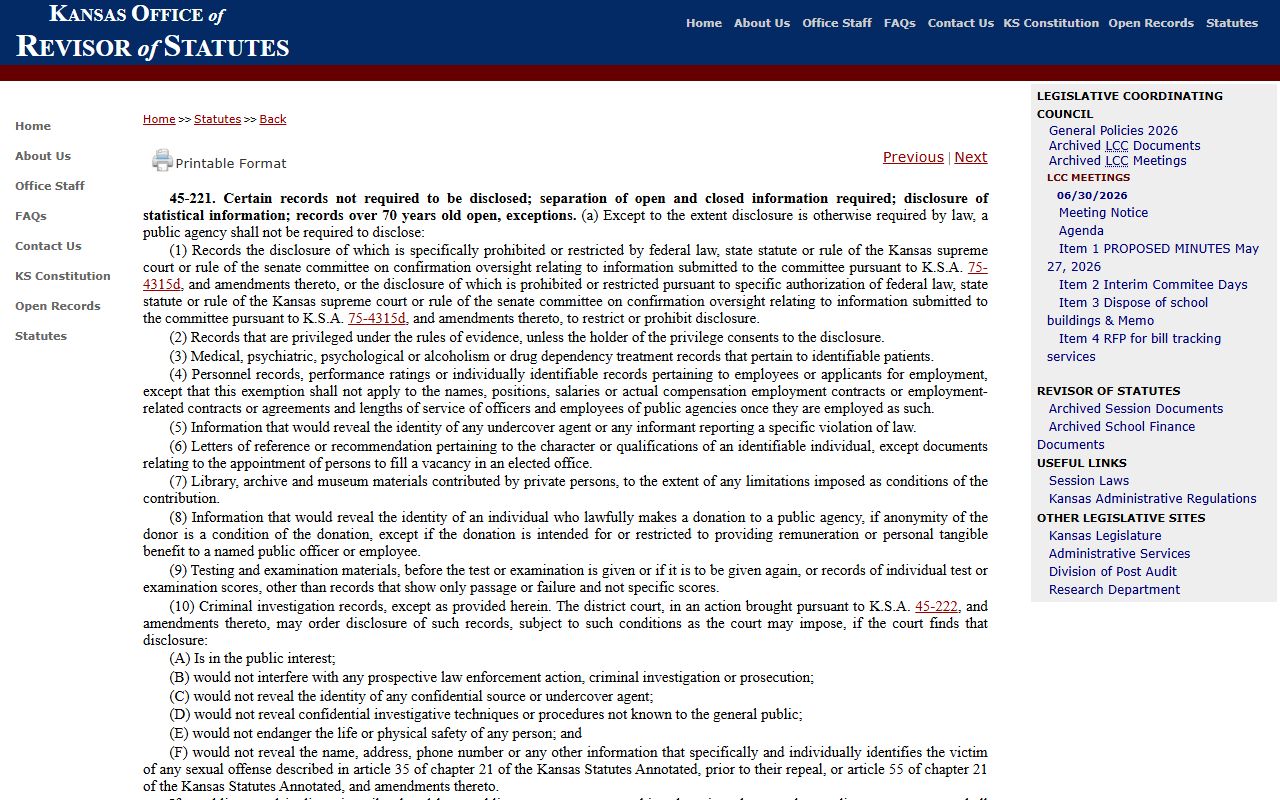
K.S.A. 45-221 explains why some court or agency records can be withheld, redacted, or routed through a separate legal process.
District Clerk or Government Clerk
Wyandotte County has a separate Unified Government Clerk, but that office is not the court-record clerk. The Unified Government Clerk handles official city and county legislative records such as commission minutes, ordinances, agendas, and local government records. The research lists that office at City Hall, 701 N 7th St, Suite 323, with phone 913-573-5260 and email clerkwest@wycokck.org.
For court cases, route requests to the Clerk of the District Court. For city or county government records outside a court file, use the Unified Government Clerk or the proper KORA records custodian. This split is important because a divorce decree, criminal judgment, probate order, or traffic disposition will not be issued by the legislative records office.
Before Visiting the Clerk
Bring enough information to identify the file. Case number is best. If the case number is unknown, use party names, filing date range, case type, and court department. For probate or marriage-license questions, use the Probate Department line. For District Court traffic from the Highway Patrol or sheriff, use the Traffic Department line. For city tickets, contact the municipal court named on the citation.
Many courthouse departments close for lunch from noon to 1:00 p.m. The public terminal is on the mezzanine floor, so allow time for security, terminal use, and counter follow-up. Certified copies, sealed record questions, and older files may take more than a quick counter visit.
Certified Copy Planning
A certified copy is different from a public search result. It usually carries court certification showing that the copy came from the official file. Courts, agencies, schools, licensing boards, and other legal processes may reject a printout if a certified decree, judgment, order, or sentencing entry is required. Ask the clerk whether the document can be certified and what fees or processing steps apply.
Some documents are easier to identify by event date than by title. For example, a divorce decree, journal entry of judgment, sentencing journal entry, probate letters, or protection order may all appear in a docket as an event. Give the clerk the case number, event date, and document name when possible, and say whether plain or certified copies are needed.
Older or Missing Files
If a record is not in CaseSearch, that does not prove the file does not exist. Older cases, restricted documents, recently filed items, and files with limited electronic document access may require terminal review or clerk help. The local court preserves public terminal access at the courthouse for this reason.
When a search fails, change only one variable at a time. Try case number, party spelling, business name, citation number, and date range. Then contact the clerk department that matches the case type.